That would be unwise.
–Spock
A few posts ago I promised to address the horrifying statement I made that vegetarianism (and even more veganism) is immoral.
That would be unwise.
–Spock
A few posts ago I promised to address the horrifying statement I made that vegetarianism (and even more veganism) is immoral.
Receipt for the Celebrated Mrs. Burns’ Stewed Oysters, Philadelphia, PA:
75 oysters parboiled and stewed, then add 3 pints of cream, 3/4 pound of best butter; season with cayenne pepper and salt to taste.
–Colonial Receipt Book: Celebrated Old Receipts used a century ago by Mrs. Goodfellow’s Cooking School; also Famous old Creole and Moravian Receipts; together with some of the best formulas of our well known modern chefs. Ed. Mrs. Frederick Sidney Giger
Last time we started looking at taking apart this particular article by a “dietician.” Our fearless leader into the heady fray of culinary nonsense thinks any diet that dismisses an entire food group is “crazy.” We also noted that Natalie seems to believe that added sugar is a whole food group, despite the fact that generations of human beings lived without it as a regular part of their diet for thousands of years. (Note that only “added sugar” is the whole food group on her crazy, restrictive diet. She specifically says that fruit, vegetables, grains, and dairy have sugar, but she can eat all of that.)
Our expert then proceeded to explain to us that cutting an entire anything from one’s diet makes it “restrictive,” and the problem with restrictive diets is that you crave the thing you can’t have. This is, of course, why smokers are advised never to give up their smoking.
This horrible restrictiveness is why Natalie feels you would be “crazy” if you tried to eliminate added sugar from your diet; though she also seems slightly unclear about what sugar is and how the body uses it. That alone should disqualify her, since Jimmy Kimmel explained to us all a while back that you are only legally permitted to avoid ingesting something if you can give a perfectly correct scientific explanation of its molecular structure.
Our gutsy guinea pig valiantly attempted a sugar-free diet for thirty days, which she thought would be “easy” because she “doesn’t crave sugar.” To be fair, though, part of the problem here could be definitions. When Natalie says “sugar” and “glucose” and “powers muscles,” these words and phrases clearly mean something different to her than they do in that little shared space we call reality. So it could be that when she said she “doesn’t crave sugar,” she might not have meant what we assume she meant.
You know, that she doesn’t crave sugar.
At least, so I assume from the list of sugary-sweet items in her daily menu. Again, definitions. I’m pretty certain Natalie thinks that things naturally sugar-packed, like a date, don’t count as sugar. So if one eats a bag of M&Ms, one “craves sugar.” If one eats a half dozen dates, one doesn’t.
If you’re interested, six dates weigh approximately forty-seven grams and have approximately twenty-seven grams of sugar. A packet of M&Ms weighs forty-seven grams and has approximately thirty grams of sugar. So her date cravings make perfect sense, don’t they?
As we have seen, our daring “dietician” was unable to keep to her crazy diet for most of the first week. Eventually, she got her feet under her a bit by substituting enormous amounts of natural sugar for the added sugar she put on things. Mostly.
My oatmeal definitely tastes a little bland without a scoop of brown sugar, so I head to the store and pick up some naturally sweet foods, such as dates, bananas, red grapes, and papaya. Problem solved…Luckily, another dietitian (and marathoner) told me to try dates, stuffed with peanut butter and sprinkled with sea salt, for the right mix of sugar and sodium. Although I don’t like to try anything new on race day, I make an exception and opt for the dates instead of the Shot Bloks
That doesn’t seem to have been quite enough, though, so in the end she had a sports drink like this one, which has 34 grams of added sugar. She tells us little until Day 12:
Do you know how annoying it is to ask a waiter if there is any sugar in the food? They look at you like you are the worst person ever. Needless to say, I’m not able to tell if there is added sugar in some of the foods I don’t prepare myself, but I do try to stick to the foods I expect have less.
And since you were totally shocked last week to find that your crackers and your Sriracha sauce had sugar in them, we can probably trust that your judgment was super-sound here, and you had no added sugar.
Day 15
Halfway there, and it’s finally starting to feel easier. I’ve become accustomed to sweetening my morning oatmeal with bananas and eating pre-workout snacks with natural sugar (dates and peanut butter, anyone?). I can definitely do this for two more weeks.
We already saw how sugar-packed dates are. What about bananas? She said she had “a scoop” of brown sugar on her oatmeal previously. One tablespoon would be about twelve grams of sugar. A banana, medium, has nineteen.
And since when is peanut butter “natural sugar?” Nearly all peanut butter has added sugar/corn syrup/glucose syrup/molasses/cane syrup.
Day 16
Googles, “Does wine have added sugar in it?”
Can’t find a definitive answer.
Pours glass of wine.
Depends on the wine, Natalie. Lots of wines do that, really. The cheaper the wine, the more likely that is. Also, alcohol….(wait for it)
IS A SUGAR.
Of course it’s a different type of sugar than glucose or fructose, and it is metabolized by the body in a different way. It would likely be fine to say that you are not having any added sugar and yet drink wine on occasion. My concern is that our “dietician” seems to be unclear about what a sugar is, and, even worse for the purposes of our experiment, also doesn’t seem to care that she is still (or may be) breaking her diet. Yet again.
Day 23
All self-control goes out the window when I’m tired. We arrived in California last night, and I’m super jet-lagged. I need an afternoon cookie to make me feel better. And let me tell you… it worked.
Didn’t manage to keep to diet. Again.
Day 26
I’ve done this long enough, and I give up! Being on vacation and trying to “diet” isn’t fun. It’s actually really terrible. So I cut this little experiment short and ordered an espresso shot in a chocolate-rimmed ice cream cone. And I’m not sad about it.
And on day twenty-six, we just give up entirely.
My problem with all this is not that Natalie gave up. It’s not that Natalie struggled. It’s that Natalie pretended to cut sugar from her diet when she never actually did. She never let her body use any other ingested fuel source; and then, after teasing her metabolic system with sugar over and over again, she gave up.
And then she said this:
This confirmed my right to roll my eyes at diets that eliminate entire food groups, because it’s nearly impossible to sustain that change for the long term. I’m a dietitian, and I wasn’t able to do it for longer than a week without a slipup.
Let me try to say it one more time, very, very nicely.
First, ADDED SUGAR IS NOT AN ENTIRE FOOD GROUP, YOU……ahem.
Second, just because you couldn’t do it, darling, doesn’t mean someone else can’t.
Third, I have just one more little bone to pick with you. Just a little one.
You have said that cutting a WHOLE FOOD GROUP is simply unsustainable, and also CRAZY. How do you explain your article entitled How to Survive a Barbecue When You’re A Vegetarian?
When all else fails, throw your own party! You’ve gone to a million burger barbecues; now it’s time to
forceinvite your meat-eating friends to an untraditional party. Sure, they can bring a salad with bacon in it, but let them know what you’re serving is all veg-head friendly. Encourage them to step out of their meat-eating comfort zone and get creative with plants.
What I would like to know is what planet our dietician is from. It seems to be a magical place where sugar is an entire food group, but meat is not. Perhaps she’s on the Good Ship Lollipop, headed to Peppermint Bay. Happy landing on the chocolate bar.
https://www.youtube-nocookie.com/embed/WLLSqpYyPD8?rel=0&showinfo=0
Most people don’t know why they’re doing what they’re doing. They imitate others, go with the flow, and follow paths without making their own.
–Derek Sivers
Today, I have in my home five workmen drilling holes through various walls in an attempt to rig a fix to an enormous plumbing leak. The apartment I rent here in Asia was built along the usual model, which was obviously inspired by Ed Wynn’s part in Babes in Toyland:
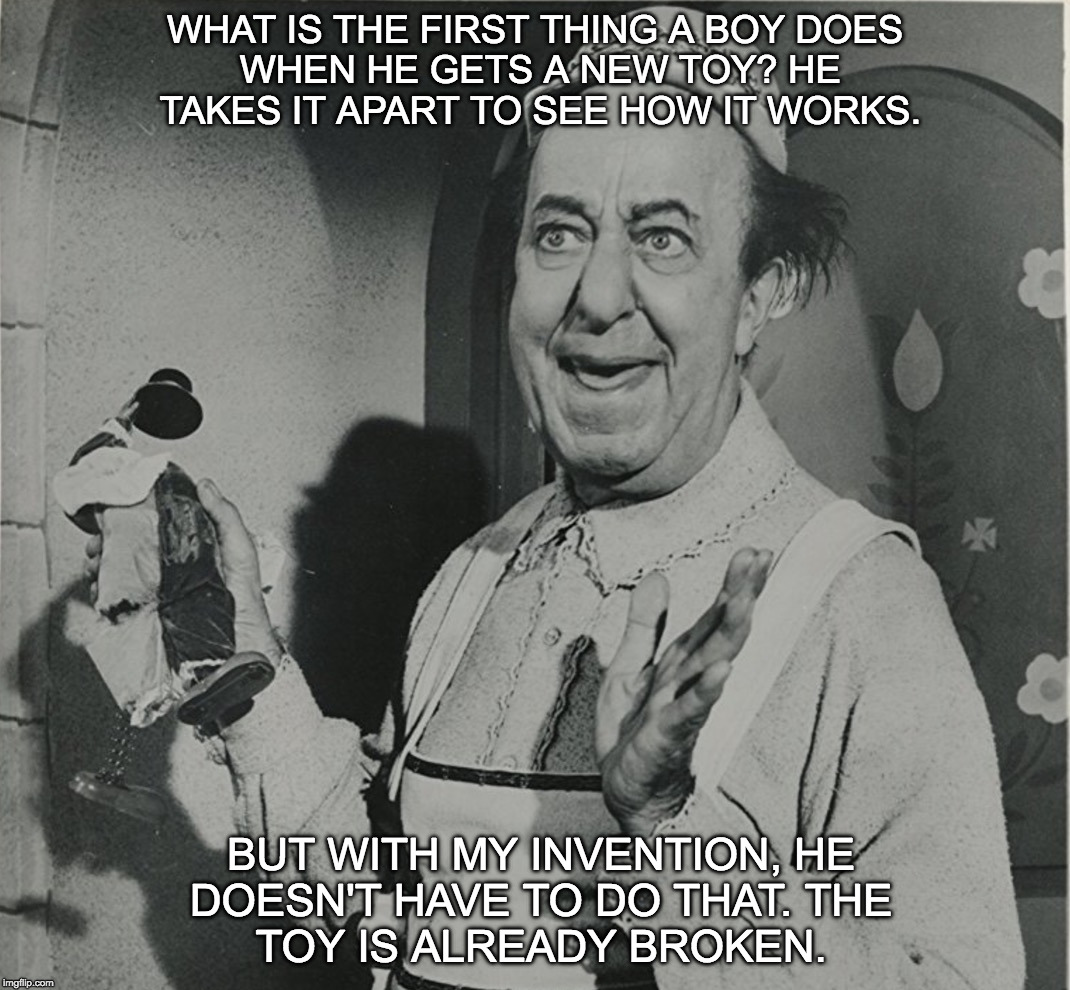
The buildings here are lucky to last ten years without enormous, expensive problems. Partly this is because companies skimp on all the cheapest materials they can get (often used) and then run away with their money after selling off the apartments. The water pipes are a particular issue.
The water has been off for some days and now they’re here drilling holes through various walls to run pipes in different directions. They have the World’s Largest Drill, which about ten minutes in blew the fuse to the kitchen and bathroom. When it did, they reasoned the thing to do was to flip the breaker and do it again. And then again. And then, the next time, it blew that fuse and the one for the whole apartment.
That’s when I started yelling.
I turned my back for a moment after yelling, and the guy tried it again. In the end, I had to physically prevent them from plugging it in again and then throw them out of the house till they replaced the fuse on their drill.
You’re probably scratching your heads. You may even doubt my story (though my readers who have lived in this part of Asia are chuckling to themselves knowingly at this point). What’s the matter with these people?
The matter is that they have no idea how to reason. Not because they are stupid, but because they were raised and educated in a system that actively beat all independent thought and reasoning curiosity out of them from a young age.
But sadly, they’re not the only ones.
Back in August, a “dietician” wrote this article about her attempt to go without sugar for thirty days. It is a beautiful example of bad thinking, wild assumptions about health and diet, and parroting of ideas she clearly has been taught but does not fully understand. Let’s have a look at her opening line:
As a dietitian, I’ve heard of every crazy diet. No dairy, no carbs, no sugar, no tomatoes, no gluten, no fat—you name it, I’ve heard of it (and have probably rolled my eyes at it).
Often we have to read a bit to get to the insane stuff, but she helpfully lets the crazy right out in the first lines.
I wasn’t aware that sugar was an essential food group. Perhaps I could get concerned if someone is eliminating a whole food group from their diet unnecessarily; but how is sugar one of those? We think that sugar was first used by the Polynesians, who took it to India, where the Persians found it in 510BC and started growing it for profit. Prior to 510BC, nearly every human on the planet was eating a sugar-free diet, as our dietician defines it. Western Europeans didn’t get sugar till after 1000. It would be hundreds of years more before it entered the regular diet of average people worldwide.
The problem with these restrictive diets is they aren’t sustainable and often cause you to crave whatever you gave up.
This is the biggest cop-out objection to eating well that you’ll ever hear. It’s like telling a smoker not to bother trying to give up the cigarettes, because he’ll just crave them. He won’t be able to not smoke because everyone smokes, and also he’ll want to smoke real bad.
Our intrepid dietician decided to try giving up sugar for thirty days, primarily so she could blog about it for cash.
I honestly thought omitting added sugar for 30 days wouldn’t be all that difficult. First, added sugar refers to sugar that is added to a food, not sugar naturally found in fruits, vegetables, grains, or dairy.
Here we get her definition of sugar-free. It’s slightly concerning. Added sugar is usually glucose or fructose or some combination(is she aware of this?), which are all found in fruit and vegetables, yes. But is she aware that grains have no sugar; or at least not enough to matter? Does she realize that the sugar in dairy is different from table sugar and requires a different digestion process? I’m not confident. More importantly, since she says fruits, vegetables, grains, and dairy all have sugar: how on earth is cutting out added sugar only to be understood as a crazy, restrictive diet that eliminates whole food groups (as she will clearly state later).
Regardless of my lack of desire for sugar, I still add a bit of brown sugar to my oatmeal, enjoy a pre-workout granola bar, and top my spoonful of peanut butter with mini chocolate chips. But that’s the extent of my sugar habit, so I figured I would be fine. Reality hurts.
Ah yes, these are the habits of someone who doesn’t crave sugar.
I’m curious whether she realizes peanut butter has sugar. And in a few minutes (SPOILER ALERT) she’s going to admit to drinking sports drinks and eating Shot Bloks. Possibly she’s underestimating her regular sugar intake? Not counting, of course, fruit and vegetables and grain and dairy.
Day 1
While eating whole-wheat crackers with my super-healthy salad (feeling great about my food choices), I check out the crackers’ ingredients label. WTF? Cane sugar! Day 1=fail.
This woman’s supposed profession is telling people how to eat, and she didn’t know the basic ingredients in whole wheat crackers?
Day 2
My oatmeal definitely tastes a little bland without a scoop of brown sugar, so I head to the store and pick up some naturally sweet foods, such as dates, bananas, red grapes, and papaya. Problem solved.
Or so I thought… until lunchtime, when I add Sriracha to my rainbow grain bowl. Surprise—Sriracha has sugar. I guess I need to read EVERY single food label.
Yes, Natalie darling: you do. Again, do you seriously want us to believe you are a professional dietician, and yet you’ve never advised your clients to be careful of food labels? Clearly, yes, you clearly have no craving for sugar. Couldn’t get through oatmeal without some extra fruit.
May I point out that you are on your second day, and you still haven’t managed to not eat added sugar?
Then the poor thing went to run a marathon. Hopefully she’s in training for running from the zombie horde, because there’s nothing else good to be derived from endless running. We’ve mentioned it before, but the “marathon” derives its name from the Greek city of Marathon, which a man named Pheidippides is said to have run to from Athens–twenty-five miles–in order to announce an important Greek battle victory.
Then he keeled over and croaked.
So naturally, we celebrate his death all over the world with various running events of twenty six miles. Marathoners are seven times more likely to have sudden cardiac death while running than during normal life. They also get scarring on the heart. Most fun of all, when recent Hartford Marathon participants were tested, turned out 82% of them presented with Stage 1 Acute Kidney Injury. And that’s not to mention the joint issues, replacement knees, and even the getting hit by cars!
Fun!
Anyway, our friend Natalie couldn’t eat tons of added sugar to go running, as she usually does, so she had to resort to other sugar. But even then, she gave up and drank an enormous amount of sugar anyway.
In other words, my usual fueling plan is loaded with sugar because sugar (a.k.a. glucose) powers muscles during endurance activity. Luckily, another dietitian (and marathoner) told me to try dates, stuffed with peanut butter and sprinkled with sea salt, for the right mix of sugar and sodium. Although I don’t like to try anything new on race day, I make an exception and opt for the dates instead of the Shot Bloks. They worked pretty well. The only problem was I got an annoying cramp around mile seven that wouldn’t go away, so I gave in and reached for a sports drink.
Dear Natalie,
I feel for Natalie. We’ll return to her story tomorrow. Meanwhile, I have to go keep an eye on the drilling.

Plato says he’s hungry
Help us keep paying for this site and feeding the dogs.
$1.00
 Ask Me How It Happened